General News
ECOWAS Council of Ministers Discusses Institutional Relocation Amid Withdrawal of Sahel States

By Iyojo Ameh
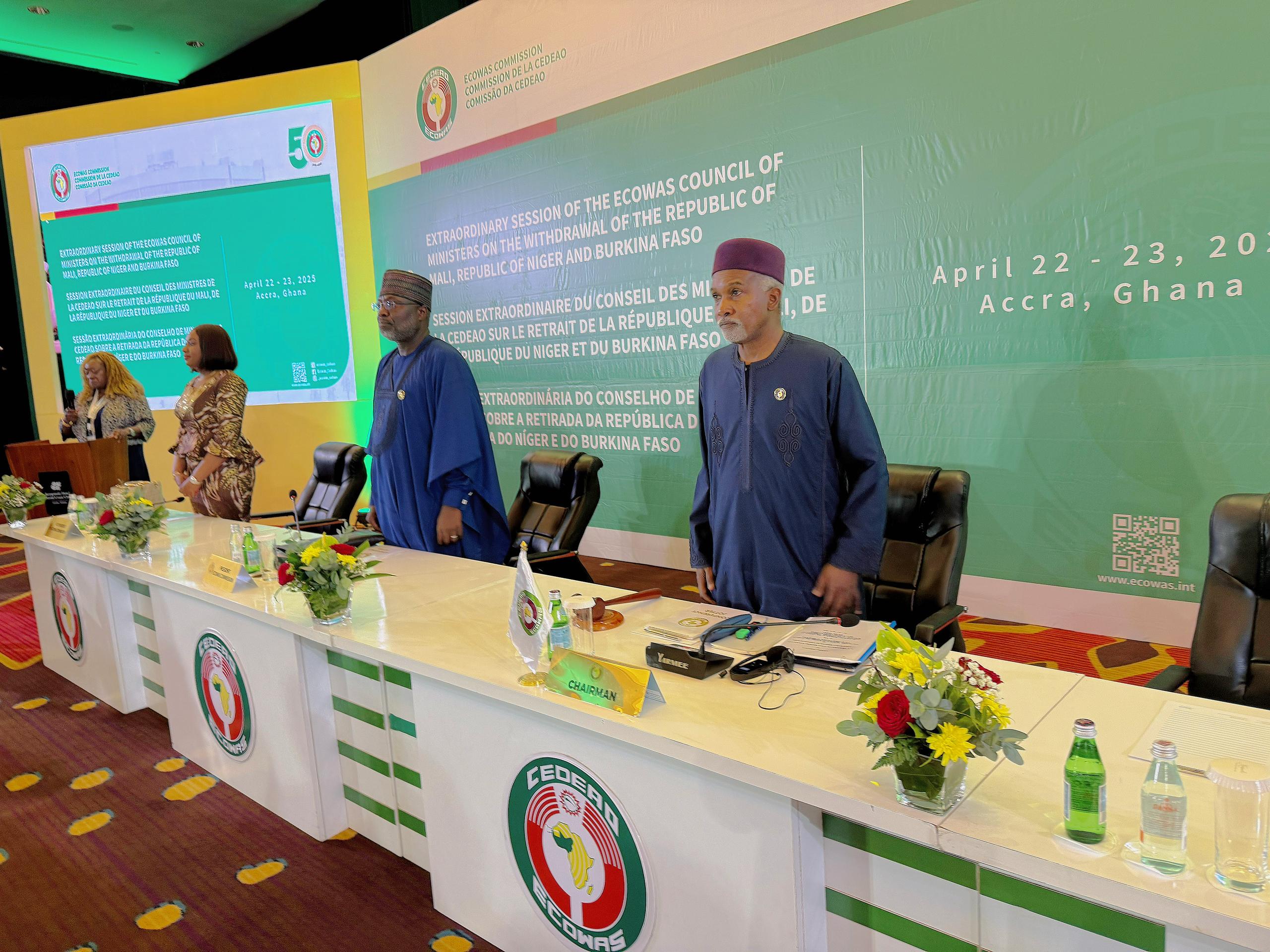
The Economic Community of West African States (ECOWAS) Council of Ministers held an Extraordinary Session in Accra on Wednesday to address urgent issues stemming from the formal withdrawal of Burkina Faso, Mali, and Niger from the regional bloc.
The session focused on the strategic relocation of ECOWAS institutions currently situated in the three Sahelian countries, as well as on broader contingency plans to mitigate disruptions to regional cooperation and integration.
Chairing the meeting was Nigeria’s Minister of Foreign Affairs, Ambassador Yusuf Maitama Tuggar, who thanked the Government and people of Ghana for hosting the deliberations and acknowledged the ongoing “ECOWAS at 50” celebrations as a timely reflection of the bloc’s achievements.
“This gathering demonstrates our unwavering commitment to the advancement of our regional community and the fulfillment of ECOWAS’s core purpose,” Ambassador Tuggar said in his opening address.
The Extraordinary Session followed a mandate issued by the Authority of Heads of State and Government during its 66th Ordinary Session, tasking the Council with adopting practical steps for managing the withdrawal process. The ECOWAS Commission is expected to present several memoranda, including proposals on program suspension in the exiting countries, movement restrictions, and the relocation of relevant agencies.
According to a statement signed by Alkasim Abdulkadir, Special Assistant on Media and Communications Strategy to the Honourable Minister of Foreign Affairs, the Council is also examining the legal and diplomatic framework for a smooth transition, should the withdrawals proceed as planned.
Ambassador Tuggar noted the significance of the moment, describing the situation as a sobering but necessary reckoning.
“It was never our wish to deliberate on the withdrawal of member states. But in recognizing the sovereignty of these nations under their current military governments, we must now adapt and chart a forward-looking path,” he stated.
Despite the challenges, the Council Chair urged ministers to see the development as an opportunity to reinforce ECOWAS’s institutional resilience and deepen its integration framework.
He reaffirmed that ECOWAS remains the most harmonized regional bloc on the continent, rooted in shared economic, political, and security objectives.
“Our unity has been tested before—and we emerged stronger. We will do so again,” Tuggar declared, calling for unity and commitment to the community’s founding ideals.
The Chair concluded with a reminder of the benefits of membership in the regional body: “Membership, as the saying goes, has its privileges.”