General News
ECOWAS at 50: Tinubu Urges Regional Leaders to Prioritise Poverty Reduction, Education, and Innovation …calls for renewed commitment to Peace, Unity and Youth Empowerment

By Iyojo Ameh
President Bola Ahmed Tinubu has called on leaders of the Economic Community of West African States (ECOWAS) to renew their focus on addressing poverty, youth unemployment, and social exclusion as the regional bloc marks its 50th anniversary.
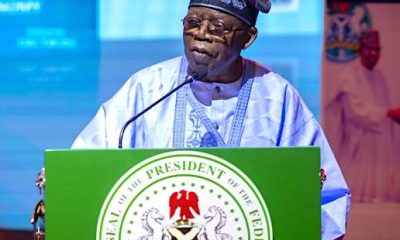
Delivering his message at the Golden Jubilee celebration in Accra on Tuesday, President Tinubu, who was represented by the Minister of State for Foreign Affairs, Ambassador Bianca Odumegwu-Ojukwu, said it was time to recommit to the founding ideals of ECOWAS and channel more investments into education, innovation, and skills development.
According to a statement signed by Mr. Magnus Eze, Special Assistant on Communication and New Media, the President said the 50th anniversary offers a unique opportunity to celebrate ECOWAS’ achievements while charting a bold new course for the future.
“Five decades ago, our founding fathers from 15 nations envisioned a region united in economic cooperation and shared prosperity,” Tinubu said. “They created ECOWAS not just to dissolve borders but to build bridges of trade, cultural exchange, and mutual progress.”
Highlighting the progress made, Tinubu applauded ECOWAS for promoting democratic governance, fostering intra-regional trade, launching the ECOWAS passport, and intervening through peacekeeping efforts in countries like Liberia, Sierra Leone, and The Gambia.
He also commended the ECOWAS Commission staff for their professionalism and dedication, and praised Ghanaian President John Dramani Mahama for his exemplary leadership and commitment to regional integration.
“Under your stewardship, Ghana remains a beacon of democratic governance, economic progress, and regional solidarity,” Tinubu said.
However, the President noted that the region still faces formidable challenges. These include widespread poverty, high youth unemployment, limited access to quality education, climate change, food insecurity, and the resurgence of unconstitutional governance.
“Our region continues to grapple with violent extremism and political instability,” he noted. “We must be bold in addressing these threats while deepening democracy and inclusion.”
Reaffirming Nigeria’s leadership role in ECOWAS as its current chair, Tinubu called for a shift towards a people-centered ECOWAS where the aspirations of the youth are prioritized.
“We must place our young, dynamic, creative, and resilient population at the heart of our agenda,” he said. “We must invest in innovation and education to unlock Africa’s future.”
He also called for urgent reforms to strengthen ECOWAS institutions and accelerate the region’s economic integration, including progress toward a single regional currency and stronger trade infrastructure.
“A prosperous West Africa is good for the continent and for the world,” he said.
Tinubu urged member states to use the Jubilee milestone as a moment of rededication to the spirit of Pan-Africanism, adding that ECOWAS must remain inclusive and open to dialogue with countries that have temporarily exited the bloc.
“In hopes of reconciliation and reintegration, we must remain open and willing to engage in sustained, constructive dialogue with our estranged brothers,” he said.
Ending on a note of unity, Tinubu stressed that collaboration remains the key to unlocking the region’s full potential.
“Our strength lies in our unity. A tree does not stand alone in the forest,” he said. “Nigeria stands ready to work with every nation—big or small—to build an ECOWAS that is resilient and equipped to meet the demands of the present and future.”
“May the next 50 years be remembered as the era when West Africa rose—united, prosperous, and unstoppable.”